Join the discussion on our Facebook Group Visit Facebook Page

Ballynilard Planning Action

Protecting our rural heritage from industrial development

NEW APPLICATION ACTIVE: Ref 2660893

Submissions close Thursday, October 15th, 2026. A new €20 submission is required, even if you objected to the first application.

View Application 2660893 on ePlanning

Protecting Our Community

A new planning application (Ref: 2660893) has been lodged with Tipperary County Council for a 90,000-tonne industrial waste processing facility and Biogas refinery at Ballynilard. The Council invalidated the first application in March, but the developers have come back with essentially the same scheme, leaving our roads, drinking water aquifer, air quality and residential amenity under threat.

We need everyone to get ready to lodge a submission again. Because the plant is largely unchanged, you don’t need to start from scratch: if you objected last time, your original arguments still stand. Update them for the changes below, put the new reference number on it, and resubmit. The deadline is Thursday, October 15th, 2026.

The developer has dropped the plan to discharge 70 tonnes of wastewater a day into the River Ara, a real win the community can be proud of!

Otherwise, the revised proposal is effectively the same industrial development: an 11.3m permanent flare stack, multiple 15.5m high silos and a 16.5m processing building, operating 24/7 within hundreds of metres of family homes and on top of a regionally important karst aquifer. The main change is that the entrance road has been shifted about 10 metres to get around the earlier land consent problems along the R662. Residents’ substantive concerns have not been addressed.

Step-by-Step: How to Lodge Online

Length: 5 Minutes | Requirement: Valid Email

Open Portal

Navigating the ePlanning portal can be confusing. This video walks you through the entire process: from registering your account to successfully uploading your letter of objection.

Key Steps Covered:

  • Creating a user account on TipperaryCC ePlanning.
  • Searching for Ref: 2660893.
  • How to pay the €20 statutory fee online.
  • Attaching your objection letter in PDF or Word format.

Password Tip for the Portal:

The registration page is very strict. To make a password that is easy to remember but strong enough to pass, use a "Picture Password":

FlyingGiraff3?

(Pick a funny animal, an action, a number, and a symbol. It's much easier than trying to remember random gibberish!)

Portal traffic increases near the deadline, and the portal went down over the weekend of the last deadline. Do not wait until October 15th!

Biogas Plant threatens Tipperary Town

Submissions on the new application close October 15th, 2026
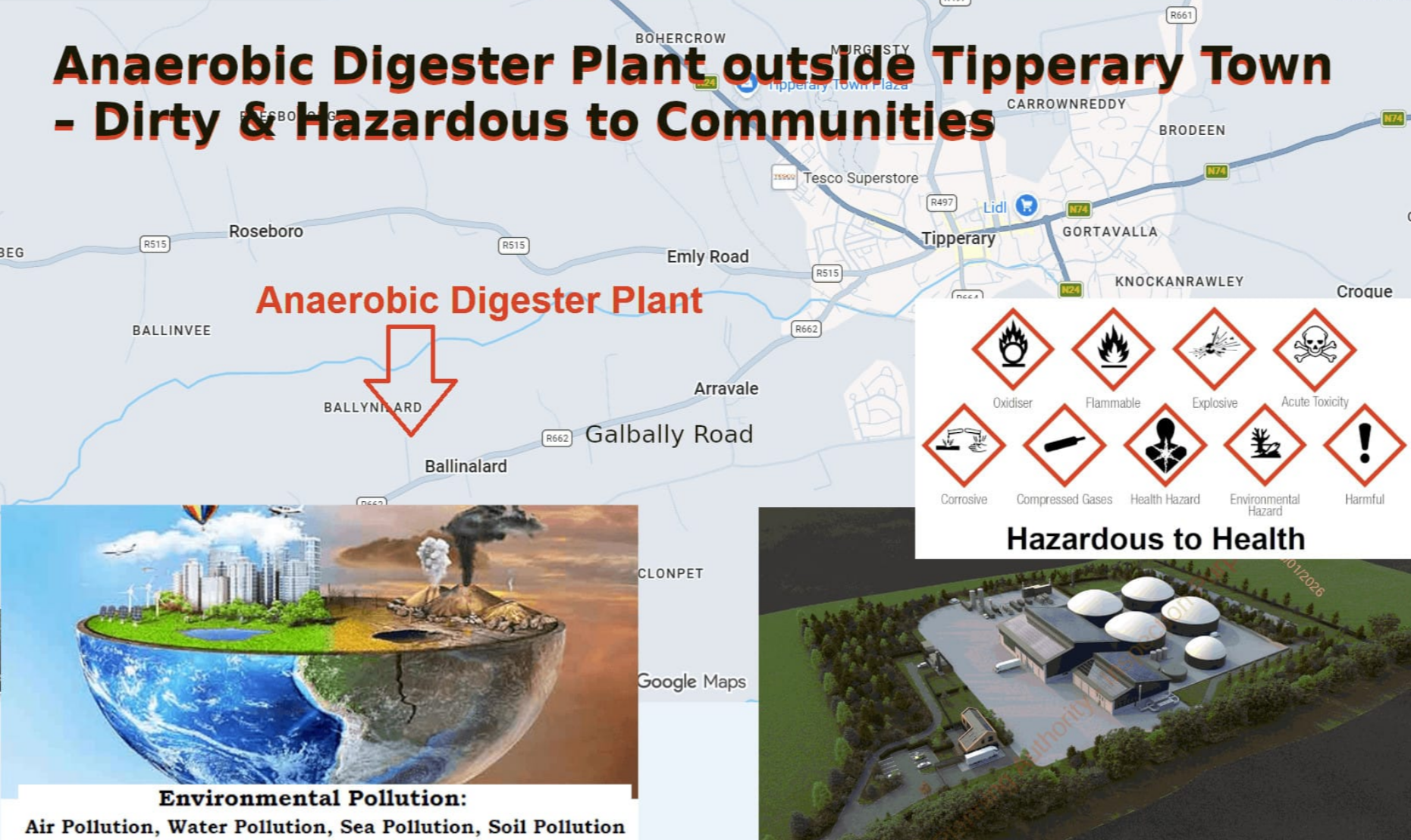
Ballynilard Biogas Disaster

Tipperary Town drinking water could get contaminated. Most of the drinking water for the town comes from wells on the Bansha road near the town. Any seepage from the digester could make its way into the aquifer that feed the wells.

The aquifer beneath Tipperary town, from which drinking water is extracted, may be vulnerable to contamination because it is recharged by groundwater that travels from many miles beyond the immediate local area. Unlike surface water sources, aquifers are part of complex underground systems where water slowly moves through layers of soil, sand, gravel, and rock. This means that pollutants introduced far from the town—such as agricultural chemicals, fertilisers, pesticides, or waste from industrial and domestic activities—can eventually seep into the groundwater and accumulate within the aquifer. The proposed site is on a karst landscape. This essentially means that any spillages of chemicals stored on site can readily reach the underlying aquifer.

Since groundwater movement is slow and difficult to monitor, contamination may go undetected for long periods, increasing the risk to public health. If harmful substances enter the aquifer, they can compromise the safety and quality of the drinking water supply, potentially exposing residents to dangerous chemicals or microorganisms. Furthermore, once an aquifer becomes contaminated, it is extremely difficult, expensive, and time-consuming to clean. Therefore, protecting the wider recharge area—not just the land directly above the aquifer—is essential to ensure a safe and reliable drinking water supply for the people of the town.
Latest Updates

Industrial Odour & Toxin Management
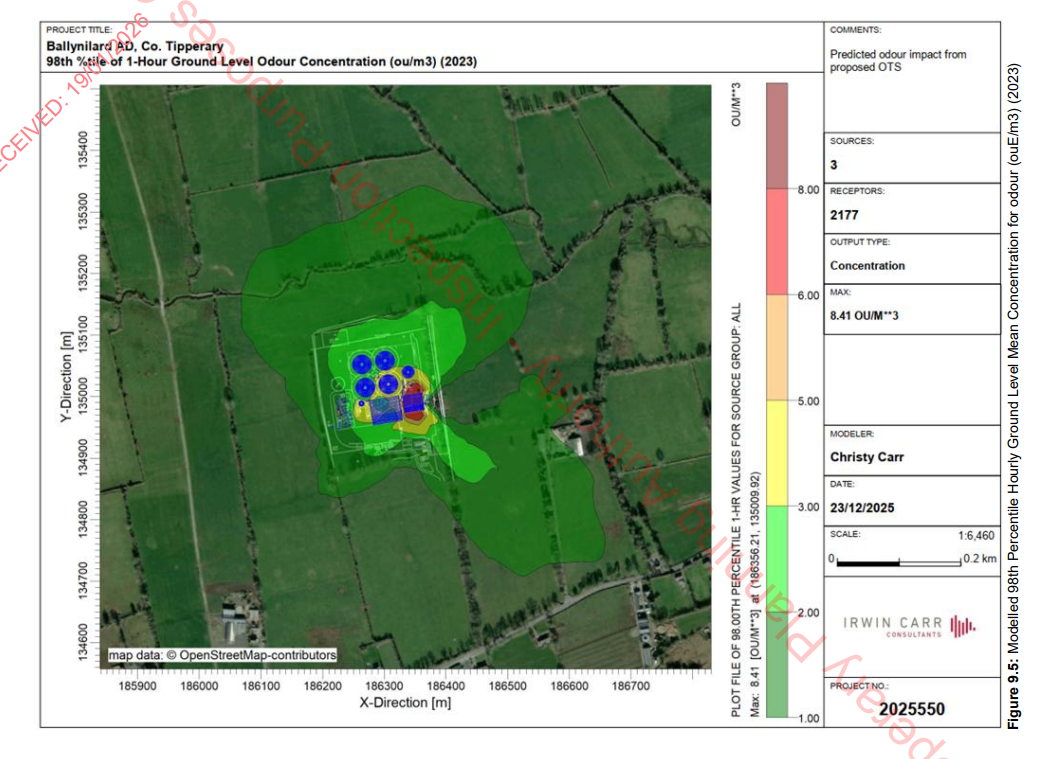
Odour Dispersion Map

Figure A: The Developer's predicted "98th Percentile" Odour spread.

Resident Map

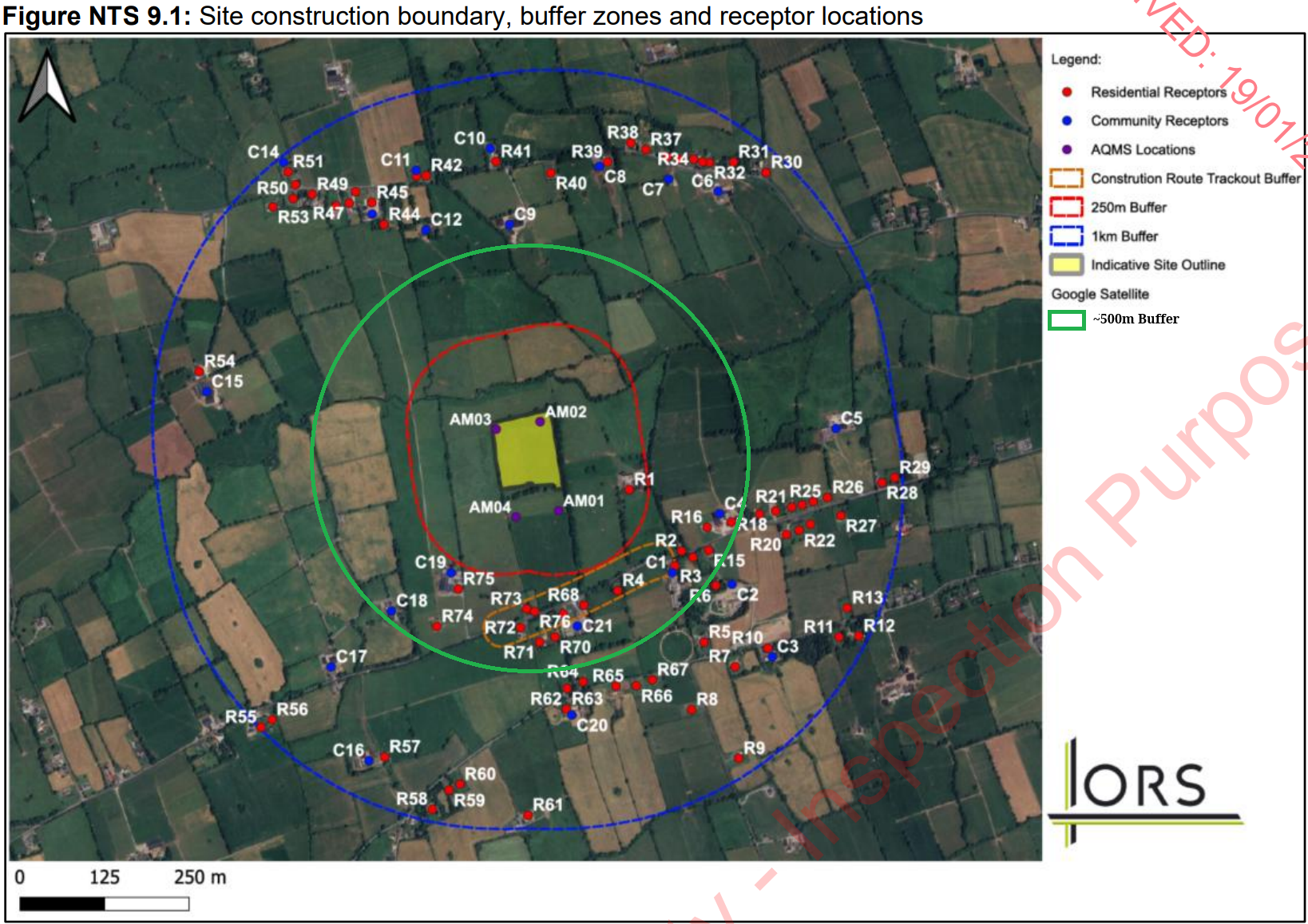
Figure B: 75 family homes identified within the immediate impact zone.

A "Perfect World" Model vs. Our Reality

The developer's EIAR claims that odour impact will be "negligible." However, their own data reveals a dangerously thin margin of safety for the families living at Ballynilard.

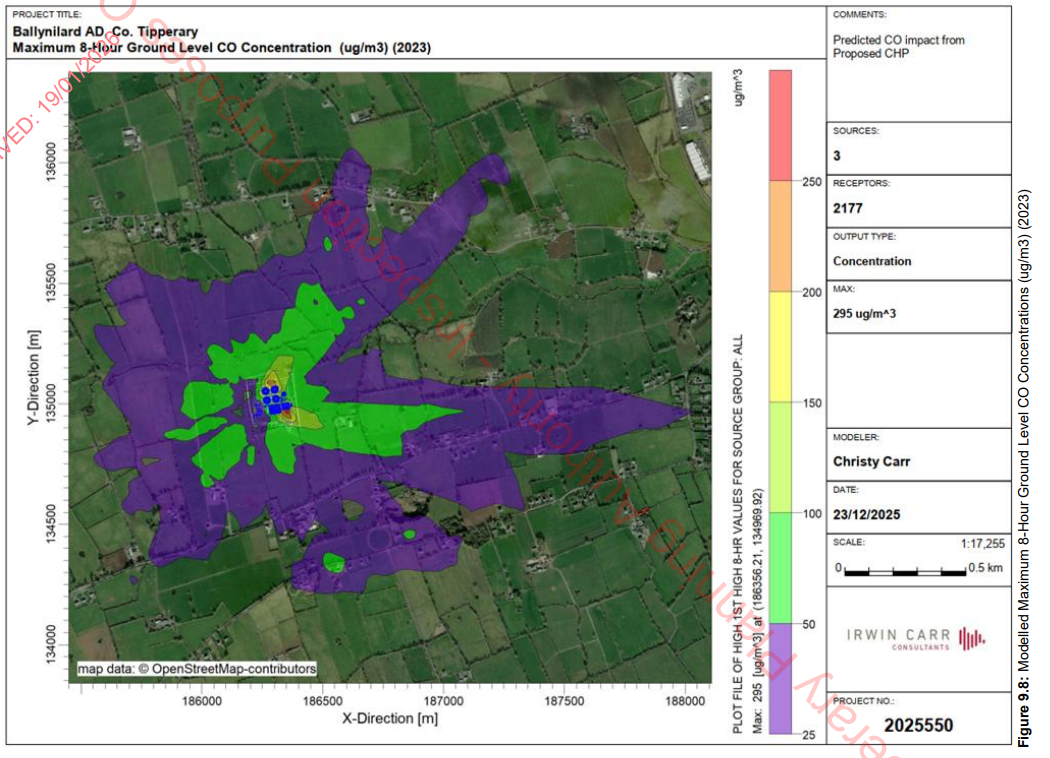
The "Hidden" Emission Sources

The 98th percentile metric ignores 175 hours of the year where odor may exceed nuisance thresholds during unfavorable weather. That's around a half hour per day

The developer's computer model only calculates emissions from the tall stacks. They have "scoped out" (ignored) several critical sources of fugitive odors and toxins, claiming they are "infrequent" or "gas-tight":

  • Pressure Relief Valves (PRVs): These are designed to vent raw biogas directly into the air to prevent tank explosions during process upsets or extreme heat. These were not included in the odor model.
  • Piping & Flanges: The model assumes "zero leakage" from kilometers of industrial piping, pumps, and valves. In reality, small leaks (fugitive emissions) are a primary source of the "industrial smell" associated with AD plants.
  • The Emergency Flare: The 11.3m flare is excluded from long-term modeling because it is for "emergency use" only. However, when a flare is active, it represents a significant failure of the system and a spike in local emissions.
The Reception Hall: A 2,000 square metre Risk

The Reception Hall is the "heart" of the odor risk, where 90,000 tonnes of waste will be tipped. The developer claims "negative pressure" will keep smells inside. But consider these facts from the report:

  • Broken Vacuums: Every time one of the 29 daily HGVs enters or exits, the "negative pressure" vacuum is compromised. Even "rapid-response" doors cannot prevent a "burp" of odorous air from escaping.
  • Low Air Exchange: The building is designed for only 2 air changes per hour. This is a low rate for an industrial waste facility, meaning odorous air lingers longer inside, increasing the pressure to escape through gaps and doors.
The 1.5 Unit Risk

The report predicts the closest home (Receptor R1) will reach 1.36 OUE/m3, just barely under their self-imposed 1.5 limit. This leaves a safety margin of only 0.14 units. Their model assumes 100% efficiency—it does not account for human error or equipment wear.

Key Questions for Your Objection

We encourage residents to include these specific technical concerns in their submissions to Tipperary County Council (Ref: 2660893):

1. Modeling Gaps: Why were "Fugitive Emissions" from kilometers of industrial piping, flanges, and the Gas Upgrading plant "scoped out" of the odour model? These are known sources of persistent industrial odour in plants of this scale.
2. Abatement Failure: The model assumes 100% uptime. What is the predicted impact on local residents during the 5-7% annual maintenance downtime when the Odour Treatment System may be offline?
3. Razor-Thin Safety Margins: The predicted impact at Receptor R1 (1.36 OUE/m3) is within 10% of the self-imposed safety limit. What independent, real-time monitoring will be required to verify these theoretical figures?
4. Toxic Gas Venting: How often are the Pressure Relief Valves (PRVs) expected to vent raw biogas (containing H2S) during process "upsets" or heatwaves, and why was this impact not included in the dispersion maps?
5. Vacuum Integrity: With 29 HGVs entering and exiting daily, how can "Negative Pressure" be realistically maintained in the reception building when bay doors are constantly cycling?
Objection Letter Template

You can copy the text below and paste it into the "Observation" box on the ePlanning portal.

To: Tipperary County Council Planning Department
Ref: 2660893
Applicant: Andrew Kiely and Nephin Renewable Gas - Ballynilard Limited

I wish to lodge a formal observation regarding the proposed Anaerobic Digestion facility at Ballynilard. My concerns relate specifically to the Odour Dispersion Modelling provided in the EIAR:

1. The model excludes "Fugitive Emissions" from industrial piping and the Gas Upgrading plant, which are known sources of chronic odor.
2. The 98th percentile metric ignores 175 hours of the year where odor may exceed nuisance thresholds during unfavorable weather.
3. The predicted level at Receptor R1 (1.36 OUE/m3) is too close to the 1.5 limit, leaving no room for mechanical failure or maintenance downtime.
4. Negative pressure claims are unrealistic given the high volume of HGV traffic and door cycles (29 per day).

I request that the Planning Authority seek further information on a "System Failure" scenario before any decision is made.
Map of affected residents
  Residences   Farms / Businesses — 500m Zone
Map of Affected Residents

This map highlights the potentially affected "receptors" (local homes and families) identified in the developer's report. The proposed plant is just over 2km from the west edge of Tipperary town. The green 500m line has been added for clarity. Red dots are the 75 residences, while blue dots are farms/businesses.

Instructions for Submitting by Post
The Deadline

Your letter must arrive no later than Thursday, Oct 15th. If posting, do so by Monday, Oct 12th to be safe.

The Fee (€20)

Include a cheque (payable to Tipperary County Council), Postal Order, or Bank Draft. Do not send cash.

Registered Post

Use Registered Post. This gives you a tracking number and legal proof of delivery should the council lose your file.


Where to Send It
Clonmel Office:
Planning Section, TCC
Civic Offices, Emmet Street,
Clonmel, Co. Tipperary. E91 N512
Nenagh Office:
Planning Section, TCC
Civic Offices, Limerick Road,
Nenagh, Co. Tipperary. E45 HE25

Submission Template Text

You can copy and paste the text below directly into a Word document and modify as needed:

To: The Planning Department, Tipperary County Council Re: Planning Application 2660893 – Nephin Renewable Gas A.D. Facility Date: [Insert Date] From: [Your Full Name], [Your Full Postal Address], [Your Eircode] To Whom It May Concern, I wish to lodge a formal observation regarding the proposed Biogas/Anaerobic Digestion plant at Ballynilard (Ref: 2660893). I object to this development based on the following concerns: 1. Wastewater & Groundwater: The replacement wastewater disposal plan is incomplete and does not demonstrate that the underlying karst aquifer, which supplies drinking water to Tipperary Town, will be protected. 2. Traffic & Infrastructure: Our town roads, specifically O'Connell Road and the Galbally Road, cannot safely sustain an additional 14,000–18,000 HGV movements annually. 3. Scale & Location: A 24/7 industrial facility of this scale, with an 11.3m flare stack and 15.5m silos, is inappropriate within hundreds of metres of family homes. Please find the statutory fee of €20 enclosed. I look forward to receiving an official acknowledgment of this submission. Yours faithfully, (Sign your name here) [Print your name here]

From the archive · March 2026

First application (Ref: 2660031) invalidated

Tipperary County Council returned the original application as Invalid, citing insufficient traffic and HGV data, failure to demonstrate sufficient legal interest in the site, and inadequate protection for the River Ara. Thank you to every neighbour who made a submission. The developer has since resubmitted under Ref: 2660893 (see above).

Council invalidation letter (PDF)